If you are in the market for a new golf cart, you are facing the single biggest technological shift the industry has ever seen. The “engine” of the electric cart its battery has been completely reinvented.
For decades, there was only one choice: a “wet” set of lead-acid batteries. These 100-year-old workhorses were heavy, messy, and high-maintenance, but they were the only option. Today, they have a challenger: the Lithium-Ion (LiFePO4) battery.
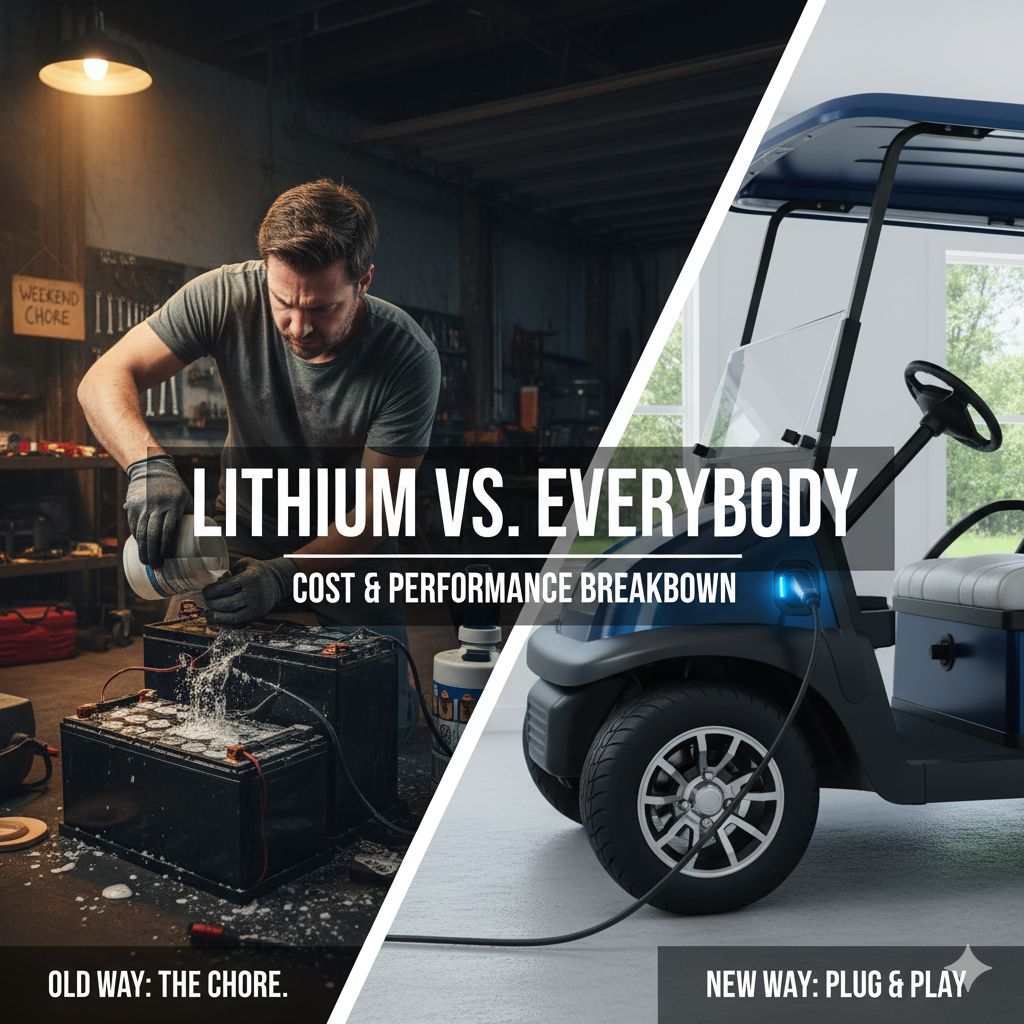
This isn’t just a simple “upgrade” like getting new tires. The debate of lithium vs lead-acid golf cart is a debate between two entirely different philosophies of ownership. One is a high-maintenance “project” that demands your time and money every month. The other is a “plug-and-play” appliance you simply get to enjoy.
But what’s the real story? Is the high up-front cost of lithium really worth it? What are the true long-term costs and performance gains?
As a premier dealer, this is the most common question we get. So we are going to answer it definitively. This is the ultimate side-by-side breakdown of Cost, Performance, and Maintenance. By the end of this post, you’ll understand all the lithium golf cart benefits and see why a maintenance-free golf cart battery isn’t just a luxury—it’s the smartest investment you can make.
1. The “10-Year Test”: A True Long-Term Cost Breakdown
This is the most important section of this entire article. Buyers often get “sticker shock” from a lithium cart, not realizing the hidden financial trap of lead-acid.
Let’s break down the real 10-year cost of ownership for a typical 48V golf cart.
The Up-Front Cost: The “Sticker Price”
- Lead-Acid: A new cart with a lead-acid battery system has a lower initial sticker price. It’s the “cheaper” option on day one.
- Lithium: A new cart with a lithium battery (like an Evolution golf cart) will cost more up-front. That premium battery is a more expensive component.
Winner (Day 1): Lead-Acid
But ownership doesn’t end on day one. This is where the math gets very, very interesting.
The “Hidden Tax”: Replacement Costs
This is the single most important factor.
- Lead-Acid Battery Lifespan: A lead-acid battery pack has a very limited “cycle life.” It’s designed to last for 300-500 charge cycles. For most owners, that is 2-5 years of use, with 3 years being a very common lifespan.
- Lithium Battery Lifespan: A high-quality LiFePO4 battery (the kind used by Evolution) is rated for 3,000 to 5,000+ full charge cycles. This translates to a realistic, usable lifespan of 10 to 15+ years.
Now, let’s do the math. A replacement set of high-quality lead-acid batteries costs, on average, $2,000 (including installation and disposal of the old, hazardous batteries).
A 10-Year Cost of Ownership Model:
- LEAD-ACID CART:
- Year 0 (Initial Purchase): $10,000 (Example Price)
- Year 3: Batteries die. Add $2,000 for replacement.
- Year 6: Batteries die again. Add $2,000 for replacement.
- Year 9: Batteries die again. Add $2,000 for replacement.
- 10-Year Total Cost: $10,000 (Cart) + $6,000 (Batteries) = **$16,000**
- LITHIUM CART (Evolution):
- Year 0 (Initial Purchase): $12,000 (Example Price, including lithium premium)
- Year 3: Battery is only 30% through its life. Cost: $0.
- Year 6: Battery is only 60% through its life. Cost: $0.
- Year 9: Battery is still going strong. Cost: $0.
- 10-Year Total Cost: $12,000
In this real-world 10-year scenario, the “cheaper” lead-acid cart actually cost you $4,000 more than the premium lithium cart. The high up-front cost of lithium isn’t a “cost” at all; it’s a “pre-payment” that saves you thousands in the long run.
The “Hidden Cost”: Wasted Electricity
This is a small but constant cost.
- Lead-Acid Efficiency: Lead-acid batteries are notoriously inefficient. They “waste” about 15-30% of the energy you put into them as heat during the charging process. You are paying for 100% of the electricity, but only storing 70-85% of it.
- Lithium Efficiency: Lithium batteries are over 95% efficient. They charge faster and waste almost zero energy as heat. You are paying for exactly what you store.
Over a 10-year lifespan, this adds up to hundreds of dollars in wasted electricity for the lead-acid owner.
The “Value” Factor: Resale
This is the final nail in the lead-acid coffin.
- Selling a 3-Year-Old Lead-Acid Cart: A potential buyer knows the batteries are at the end of their life. Their first question will be, “How old are the batteries?” When you say “three years old,” they will immediately deduct $2,000 from their offer, and rightfully so.
- Selling a 3-Year-Old Lithium Cart: You are selling a cart that still has 7+ years of reliable, maintenance-free battery life left. It has a higher resale value and is infinitely easier to sell.
10-Year Cost Winner: Lithium (by a landslide).
2. The “Performance & Power” Breakdown (Why Lithium Feels Better)
Cost is one thing. The driving experience is another. This is where the lithium golf cart benefits become impossible to ignore. The “engine” of your cart fundamentally changes how it drives.
The “Weight” Difference (The 300lb Anchor)
- Lead-Acid Weight: A typical 48V set of lead-acid batteries weighs 350-400 pounds. It’s like driving around with two extra adult passengers, all the time.
- Lithium Weight: A 48V lithium battery pack weighs 60-80 pounds.
This is a 300+ pound weight reduction. This is a massive difference, and it impacts everything:
- Faster Acceleration: With 300+ lbs less weight to move, the AC motor can instantly apply its torque to the wheels. The cart feels “zippy,” “peppy,” and fun. It’s night and day.
- Better Hill Climbing: The motor isn’t fighting an extra 300 lbs of dead weight. It can climb hills faster, with less strain, and without slowing down. This is especially true on rugged, lifted models like the Evolution D5 Maverick.
- Less Wear & Tear: That 300 lbs puts a constant, crushing load on your cart’s frame, suspension, and (most importantly) your brakes. The lighter lithium cart is far less stressed, leading to a longer life for all components.
- Less Turf Damage: For golfers, 300 lbs less weight is a huge deal. The cart is gentler on delicate fairways and greens, leaving fewer tracks and compacting the soil less.
The “Voltage Sag” Phenomenon (The “Limp Home” Effect)
This is the “killer” of the lead-acid experience.
- Lead-Acid Performance: Lead-acid batteries suffer from “voltage sag.” As the battery capacity drops, the voltage it can deliver also drops.
- What this feels like: At 100% charge, the cart is fast. At 80%, it feels a little slower. At 50%, it’s noticeably sluggish. That hill it flew up an hour ago? It now struggles to climb. The last 30% of its charge is a slow, frustrating “limp home” with almost no power.
- Lithium Performance: Lithium batteries are “voltage stable.” They deliver 100% of their power from 100% charge all the way down to 10% charge.
- What this feels like: Your cart feels exactly as fast, peppy, and powerful at 20% battery as it does at 100%. The “limp home” is gone. The cart is 100% capable until the battery is empty. This gives you confidence and a vastly superior, more consistent driving experience every single time. This is a benefit you’ll see praised in countless owner reviews.
Performance Winner: Lithium (and it’s not even close).
3. The “Ownership Experience” Breakdown (Your Time vs. Your Money)
This section is about your life. Your free time. Your weekends. This is where the maintenance-free golf cart battery becomes the only option for smart buyers.
The “Nightmare” of Lead-Acid Maintenance
To own a lead-acid cart is to be a part-time battery-scientist and mechanic. You don’t have a choice. If you neglect these duties, your $2,000 battery pack will die in 1-2 years instead of 3-5.
Here is the real, non-negotiable monthly maintenance checklist for a lead-acid cart:
- Gear Up: Put on safety glasses and acid-resistant gloves. The liquid in your batteries is sulfuric acid. It burns skin, eats clothes, and can cause permanent blindness.
- Clean the Bay: Open the heavy seat. The batteries are likely covered in a layer of grime and acidic dust. Wipe it all down.
- Pop the Caps: Carefully pry off all 18 or 24 individual cell caps, trying not to let them fall into the dark, grimy bay.
- Check the Water Levels: Get a flashlight and peer into every single cell. The water level (electrolyte) must be above the lead plates but below the fill-well.
- The “Distilled Water” Chore: Get your gallon of distilled water (tap water has minerals that will kill the battery). Carefully, painstakingly, top off every single low cell.
- The “No-Win” Scenario: If you under-fill, the plates are exposed and will be destroyed. If you over-fill, the battery will boil over on its next charge, spitting corrosive sulfuric acid all over your battery bay, cables, and—worst of all—your cart’s steel frame, which it will silently eat, leading to catastrophic rust.
- The “Corrosion” Chore: You will see a white, crusty, “crystal-like” growth (lead sulfate) on your battery terminals. This is not just “dirt”; it’s a battery-killing cancer that blocks the flow of electricity.
- The “Baking Soda” Scrub: You must disconnect the thick cables, mix a paste of baking soda and water, and use a wire brush to scrub every single terminal and cable-end until they are clean. It’s a messy, awful job.
- Rinse and Re-Connect: Carefully rinse and dry the terminals, re-connect the cables in the correct order, and apply an anti-corrosion spray.
- The “Danger”: While charging, these batteries release highly explosive hydrogen gas. They must be charged in a well-ventilated area, away from any open flame or spark (like a water heater).
This is a 1-2 hour job, every single month. If you pay a dealer to do it, it’s a $100+ service call. This is the “cost of ownership” for lead-acid.
The “Dream” of Lithium (The Maintenance-Free Battery)
Now, here is the complete, definitive maintenance checklist for an Evolution lithium battery.
- …
- …
- …
That’s it. There is nothing on the list.
The Evolution cart maintenance-free golf cart battery is 100% sealed.
- NO water to check.
- NO acid to spill.
- NO corrosion to scrub.
- NO gassing to ventilate.
It is a true, “plug-and-play” appliance. You plug it in to charge. You unplug it to drive. For the entire 10-15 year lifespan of the battery, you will never, ever have to do a single one of those lead-acid chores.
How much is your time worth? How much is your weekend worth?
The Charging Revolution
The daily “living with it” experience is also transformed.
- Charge Time: A lead-acid cart needs a long, 8-12 hour charge. A lithium cart charges from empty to full in 4-6 hours, or 2-3x faster.
- “Opportunity Charging”: This is the biggest lifestyle change. A lead-acid battery hates being partially charged. It must complete its full, long cycle. A lithium battery loves it. You can treat it like your phone. Get home from a ride with 60%? Plug it in for an hour while you make dinner and top it off. You’re always ready to go.
Ownership Experience Winner: Lithium. It’s not just a win; it’s a total knockout.
The Final Verdict: Why “Lithium vs. Everybody” is a One-Sided Fight
The debate is over. The data is clear.
- Lead-Acid is a high-maintenance “liability.” It’s a 100-year-old technology that costs you more money over its lifespan, costs you time every single month, and delivers a worse performing vehicle.
- Lithium is a zero-maintenance “asset.” It is a modern, high-performance technology that is cheaper over its 10-year life, saves you time and hassle, and delivers a faster, lighter, more powerful driving experience.
This is why Evolution golf carts have built their entire platform around this superior technology. They don’t offer lead-acid, not because they can’t, but because it’s an inferior product. They chose to give their customers a better, smarter, and more valuable vehicle right from the start.
When you see the higher sticker price on a premium lithium cart like a D-Max GT4 or a Ranger, you now know the truth. You’re not paying more. You’re just paying once.
Stop buying a weekend chore. Invest in your free time.
Ready to experience the future of electric vehicles?

 English
  Spanish
  German
  Italian
  Polish
  Russian
0 Comments