
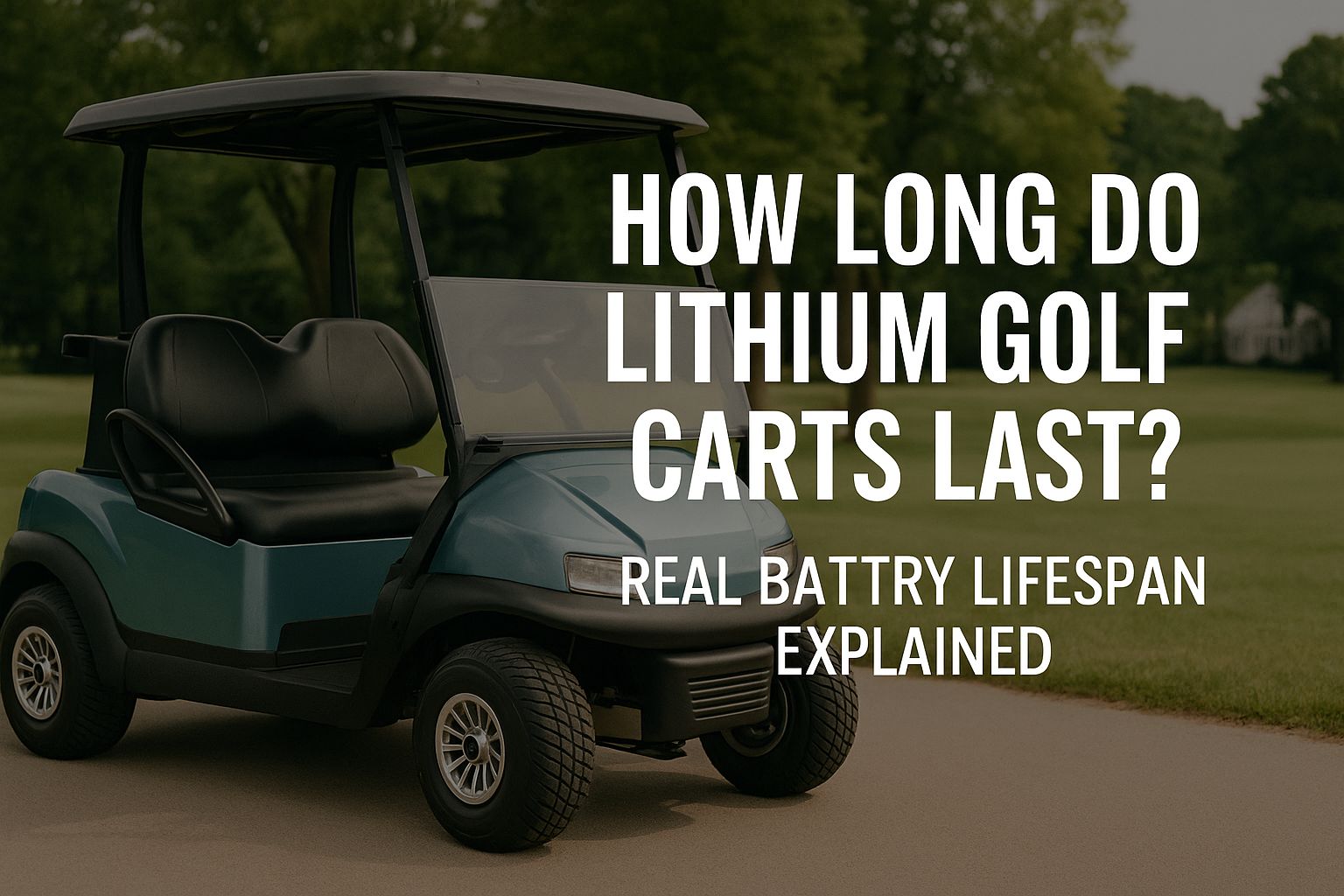
Lithium-powered golf carts have taken over the golf cart industry, replacing outdated lead-acid technology and reshaping what buyers expect in terms of power, convenience, and long-term value. But one question every buyer asks is: How long do lithium golf carts actually last?
This complete 3000-word guide breaks down the real lithium golf cart lifespan based on chemistry, charge cycles, maintenance, charging habits, battery size, usage patterns, environment, and brand quality. You’ll also learn how lithium compares to lead-acid, how to extend your battery life, and the true cost savings over years of ownership.
What Is the Average Lithium Golf Cart Lifespan?
Lithium golf carts typically last 10–15 years, while their batteries last 8–12 years depending on usage and maintenance. This is 3–5X longer than traditional lead-acid batteries.
This exceptional longevity is what makes lithium the #1 choice for:
- Homeowners
- Neighborhood riders
- Beach towns
- RV resorts
- Commercial fleets
- Rental properties
- Golf courses
- Resorts & hotels
A lithium-powered cart remains reliable for years with minimal maintenance.
Why Lithium Batteries Last So Long
Lithium batteries use advanced chemistry that allows them to maintain stable voltage, run cooler, and operate efficiently over thousands of charge cycles.
Key reasons for superior golf cart battery life:
- No sulfation (the #1 cause of lead-acid failure)
- Minimal degradation per charge cycle
- Smart Battery Management Systems (BMS)
- Cooler operating temperatures
- Zero maintenance design
- Higher usable capacity without damaging the battery
Lithium doesn’t weaken rapidly like lead-acid — it declines slowly and predictably.
Lithium vs Lead-Acid Lifespan Comparison
Here’s how lithium compares directly to traditional deep-cycle lead-acid batteries.
Lithium Battery Lifespan
- 8–12 years average
- 3,000–5,000 charge cycles
- Maintains 80% capacity for years
- Zero maintenance required
Lead-Acid Battery Lifespan
- 2–4 years average
- 300–500 charge cycles
- Loses capacity quickly
- Requires monthly watering & cleaning
- Prone to corrosion & sulfation
Lithium lasts up to 5X longer.
How Charging Cycles Affect Lithium Golf Cart Lifespan
Lithium batteries are rated by charge cycles. A cycle is one complete charge from 0% → 100%. But unlike lead-acid, lithium batteries:
- Don’t need full charges
- Aren’t damaged by partial charges
- Can be topped off anytime
Charge Cycle Estimates:
- Daily driver: 7–10 years
- Moderate use: 10–12 years
- Light use: 12–15+ years
Partial charges significantly extend battery life.
How Long Does a Lithium Golf Cart Run Per Charge?
Range varies by battery size:
Standard 100Ah lithium: 25–35 miles
Upgraded 130Ah lithium: 40–50 miles
Long-range 150Ah lithium: 60–80 miles
Bigger battery = less stress → longer lifespan.
Real-World Factors That Affect Battery Life
Lithium is durable, but lifespan can vary based on:
✔️ Climate & Temperature
- Excessive heat shortens lifespan
- Moderate climates extend battery life
✔️ Terrain & Weight
- Heavy loads require more power
- Steep hills use more cycles
✔️ Charging Habits
Best practices include:
- Keep battery between 20%–90% for daily use
- Don’t leave at 0% for long periods
- Avoid prolonged extreme heat storage
✔️ Battery Size
Larger batteries → longer lifespan because they’re not pushed as hard.
How to Make Your Lithium Battery Last 10–15 Years
Here are the top practices to maximize golf cart battery life:
✔️ Charge after rides (don’t wait for 0%)
✔️ Avoid leaving the cart unplugged for months
✔️ Store in cool environments
✔️ Use the correct charger
✔️ Avoid full discharge cycles
✔️ Check battery terminals twice yearly
✔️ Drive smoothly & avoid constant flooring
With proper care, lithium batteries can exceed 12+ years.
Signs Your Lithium Battery Is Aging
Even high-quality lithium batteries eventually degrade.
Signs include:
- Reduced range
- Increased charging time
- Lower peak power
- BMS warnings
Range loss is slow — not sudden like lead-acid.
Cost Breakdown: Are Lithium Batteries Worth It?
Lithium costs more upfront but delivers enormous long-term savings.
Lifetime Cost Comparison
Lithium (10–12 year life):
- One battery purchase
- Zero maintenance
- Higher efficiency
Lead-acid (2–4 year life):
- 3–5 battery replacements
- Watering & corrosion maintenance
- Higher electric costs
Lithium saves thousands over a decade.
Best Golf Carts with Long-Lasting Lithium Batteries
These models offer elite range, lifespan, and performance.
1. Evolution D5 Ranger
- 130Ah or 150Ah lithium
- Smooth ride, premium tech
2. Evolution D5 Maverick
- Strong torque, great for hills
3. Evolution D5 Carrier
- 6-seat long-range family cart
4. E‑Z‑GO ELiTE Series
- Uses Samsung SDI lithium technology
5. Club Car Lithium Models
- Excellent build quality
Frequently Asked Questions
How many years do lithium golf cart batteries last?
8–12 years with proper care.
Can lithium golf carts last 15 years?
Yes — with moderate usage, proper charging, and a quality battery.
Is lithium better than lead-acid?
Yes — lithium is lighter, more powerful, longer lasting, and maintenance-free.
Is a lithium upgrade worth it?
Absolutely. Over a 10-year period, lithium is cheaper and far more reliable.
Final Verdict: How Long Do Lithium Golf Carts Really Last?
Lithium golf carts last significantly longer than older lead-acid models. With modern lithium batteries offering 8–12 years of life — and many exceeding 15 years with proper care — buyers can expect exceptional value, performance, and reliability.
If you want the longest-lasting golf cart possible, lithium is the only smart choice in 2025 and beyond.
Explore long-lasting lithium carts here:

 English
  Spanish
  German
  Italian
  Polish
  Russian
0 Comments