
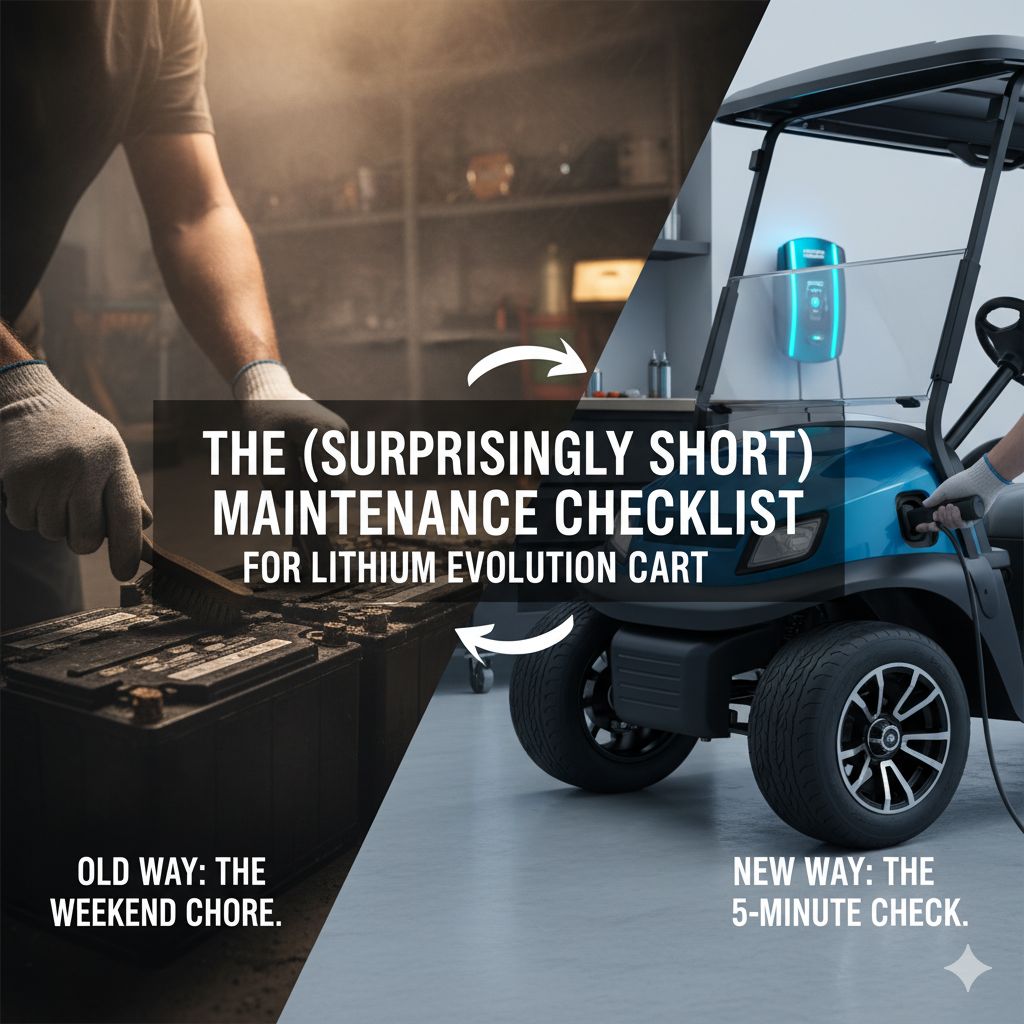
For decades, the “how to maintain golf cart” guide has been a manual of dirty jobs, hidden costs, and weekend-ruining chores.
If you’re a seasoned cart owner, you know the drill. It’s the “Sunday ritual.” You put on your old clothes and a pair of safety gloves. You heave the heavy seat open, exposing a dark, grimy bay filled with a complex web of thick cables and 6 (or 8) massive lead-acid batteries. You smell the faint, acrid scent of sulfur.
Your checklist begins. You pop the 18 (or 24!) individual cell caps, carefully peering into each one with a flashlight. You grab your gallon of distilled water (never tap water!) and painstakingly top off each cell, trying not to overfill, which would cause corrosive acid to boil out during the next charge. You see the white, crusty corrosion (lead sulfate) blooming on the terminals, so you grab your baking soda, water, and a wire brush to scrub it all off. You check the cables for tightness, apply an anti-corrosion spray, and then, after all that… you just hope. You hope they hold a charge for another season. You hope you don’t get stranded at the community pool.
This frustrating, messy, and constant process has been the “cost of ownership” for golf carts since their inception.
…Until now.
If you are new to the world of modern electric vehicles, we have good news: That world is dead.
The single greatest revolution in the last 50 years of personal electric vehicles has been the combination of two technologies: the maintenance-free LiFePO4 (Lithium) Battery and the sealed AC (Alternating Current) Motor. Evolution golf carts have built their entire brand around this new, superior technology.
The result? That long, dirty maintenance checklist has been almost completely eliminated.
This is not an exaggeration. The “hassle” of ownership is gone. This article is the new guide. We will detail the “nightmare” of the old way, show you why the new way is better, and then provide the complete—and surprisingly short—Evolution cart maintenance checklist.
Part 1: The “Nightmare” — A Deep Dive into Old-School Maintenance
To truly appreciate the “easy” checklist, you must first understand the “hard” one. For anyone who has only owned an old lead-acid cart, you’ll be nodding in painful agreement. For the new buyer, this is what you are thankfully avoiding.
The Problem: The 100-Year-Old Battery Technology
A lead-acid battery is, at its core, the same technology that’s been around for over a century. It involves lead plates suspended in a liquid bath of sulfuric acid (electrolyte). This “flooded” design is the source of 100% of the maintenance and 90% of all “golf cart problems.”
Here is the real-world, monthly checklist for “how to maintain golf cart” (the old way).
Monthly Battery Maintenance (The “Non-Negotiable” Chore):
- Gear Up: Put on safety glasses and acid-resistant gloves. Sulfuric acid will burn skin and permanently blind you.
- Clean the Surface: Wipe down the tops of all 6 or 8 batteries. Any dirt or grass can conduct electricity between terminals, slowly draining them.
- Inspect Terminals: Look for the “white crust” (sulfation). This is a battery-killing cancer. It means your battery isn’t just dirty; it’s losing capacity.
- Disconnect: Disconnect the main battery cables.
- Scrub Terminals: Create a 50/50 paste of baking soda and water. Vigorously scrub every single battery terminal and cable-end with a wire brush until all corrosion is gone. This is messy, tedious work.
- Rinse & Dry: Carefully rinse the terminals (without getting water into the cells) and dry them completely.
- Reconnect & Protect: Reconnect all cables to the correct torque. Coat every terminal with an anti-corrosion gel or spray.
- Pop the Caps: Carefully pry off all 18 or 24 individual cell caps.
- Check Water Levels: Visually inspect the electrolyte level in every single cell. The liquid must be above the lead plates but below the fill-well.
- Refill Cells: Using only distilled water (tap water contains minerals that will permanently damage the plates), carefully refill each low cell. A battery-filling “gun” is highly recommended to avoid overfilling.
- The “Boil-Over” Risk: If you overfill, the battery will spit corrosive acid all over its bay, your frame, and your garage floor during its next charge cycle. This acid eats the steel frame, leading to catastrophic rust and frame failure.
- Replace Caps: Securely press all 18-24 caps back on.
- Clean Up: You now have acid, lead particles, and baking soda paste all over your work area.
This one-hour, messy, and hazardous process must be done every 30-45 days. If you fail to do it, your $2,000 battery pack will die in 1-2 years.
The Constant Charging “Hassle”:
- 12-Hour Lock-In: A lead-acid pack must be charged in one long, 8-12 hour cycle.
- No “Opportunity Charging”: If you take a short ride and plug it in for an hour, you damage the battery. You must commit to the full cycle.
- “Memory”: If you only use 20% of the battery and then charge it, it can develop a “memory” and lose its ability to use its full capacity.
- Hydrogen Gas: While charging, lead-acid batteries release explosive hydrogen gas. They must be charged in a well-ventilated area, away from any sparks (like a water heater).
The “Old Motor” Problem (DC Motors): Older carts (and many new, cheap models) use DC (Direct Current) motors. These motors use “brushes” to make electrical contact. These brushes are a physical wear-and-tear item, just like brake pads. They spark, create carbon dust, and will eventually wear down completely, leaving you with a dead motor that needs an expensive rebuild.
The “Old Brakes” Problem (2-Wheel Mechanical): The old standard was 2-wheel mechanical drum brakes. A single cable (like a bicycle brake) pulls on two small brake shoes in the rear only. This cable stretches, it rusts, and it provides almost zero stopping power in the rain.
The Inevitable, High-Cost Replacement: After 3-5 years of this perfect maintenance, your lead-acid batteries will die. Their capacity will fade until they can’t get you around the block. You will then face a $1,500 – $2,500 replacement bill, and the entire cycle of maintenance begins again.
This is the “how to maintain golf cart” world that Evolution has made obsolete.
Part 2: The “Revolution” — Why Your New Checklist is So Short
The Evolution cart maintenance checklist is short for two reasons: the LiFePO4 battery and the AC motor.
1. The LiFePO4 Lithium Battery (The “Heart”)
Evolution carts don’t use lead-acid. They use a standard 48V LiFePO4 (Lithium Iron Phosphate) battery pack. This is the single most important component for eliminating maintenance.
- It’s 100% Sealed: There is no liquid. There are no lead plates. There are no cell caps. There is nothing to check, nothing to fill, and nothing to water.
- Zero Corrosion: Since there is no acid and no gassing, the terminals will never corrode. The “baking soda scrub” is gone forever.
- No “Memory”: The battery has no “memory.” You can use 10% and plug it in. You can use 80% and plug it in. You can charge it for 20 minutes or 6 hours. It doesn’t matter. This is Opportunity Charging, and it allows you to treat your cart like your smartphone.
- Smart BMS: A built-in “Battery Management System” (BMS) acts as the battery’s brain. It automatically protects the cells from overcharging, over-discharging, and keeps them all in perfect balance. You can’t “mess it up.”
- No Gas, No Fumes: It’s a stable, sealed chemical system. It releases zero gas and has no smell. You can charge it in your garage right next to your car with zero risk.
- 8-Year Warranty: It’s designed to last 3,000-5,000+ charge cycles, which is 10-15+ years for most users. It’s backed by an industry-leading 8-year warranty.
The entire 13-step monthly battery nightmare is replaced by one step: Plug it in.
2. The Brushless AC Motor (The “Muscle”)
Evolution carts use a modern AC (Alternating Current) Motor.
- It’s Sealed & Brushless: Unlike a DC motor, an AC motor has no brushes. There are no internal parts that “wear out” from use.
- Zero Maintenance: The motor is a sealed unit. It requires no service, no cleaning, and no rebuilding. It is, like the battery, a “run-it-forever” component.
The entire motor-rebuild problem is gone.
3. The 4-Wheel Hydraulic Brakes (The “Safety”)
High-end models like the Evolution D-Max GT4 use an automotive-grade 4-wheel hydraulic disc brake system.
- It’s a Sealed System: Just like your car, the brake fluid is in a sealed master cylinder and lines. It’s not an open cable that can rust or stretch.
- Self-Adjusting: The disc brake calipers are self-adjusting. There is no “brake cable tightening” to be done.
The entire cable-adjustment and “weak brake” problem is gone.
Part 3: The (Surprisingly Short) Evolution Cart Maintenance Checklist
So, after eliminating 99% of the old chores, what are you actually supposed to do for your lithium golf cart care? Here is the new, complete list.
It’s short. It’s easy. And it’s what you’d do for any modern vehicle.
1. (Monthly) Check Your Tire Pressure
This is, by far, the most important piece of actual maintenance you will do.
- Why It’s Critical: Your tire pressure affects three things: Range, Safety, and Wear.
- Range: Under-inflated tires have more “rolling resistance,” which means the motor has to work harder to move the cart. This can dramatically reduce your battery’s range. Keeping your tires properly inflated is the #1 way to ensure you get the maximum 40-60+ miles per charge.
- Safety: Under-inflated tires can feel “spongy” and “wobbly” in turns, making the cart less stable. Over-inflated tires can make the ride harsh and reduce traction.
- Wear: Improper inflation will cause your tires to wear out unevenly and prematurely.
- How to Do It:
- Get a simple, pencil-style or digital tire pressure gauge.
- Find the recommended PSI (Pounds per Square Inch) on the sidewall of your tire.
- Street Tires: For carts like the Evolution D5 Ranger, which are used in communities, the pressure is typically between 20-25 PSI.
- Off-Road Tires: For a “beast” like the Evolution D5 Maverick, the aggressive off-road tires may have a different pressure, often slightly lower (e.g., 15-20 PSI) to get a better “grip” on soft terrain. Always follow the number on the tire’s sidewall.
- Check the pressure when the tires are “cold” (before you drive).
- Use a simple bike pump or a small air compressor to add air as needed.
- Time Required: 3 minutes, once a month.
2. (Every 6 Months) Visually Inspect Your Brakes
You don’t have to “adjust” your brakes, but you should “know” them. Evolution’s 4-wheel hydraulic disc brakes are fantastic, but they are still a wear-and-tear item, just like in your car.
- Why It’s Critical: They stop you. This is the most important safety system on your cart.
- What to Look/Listen For (The “Feel Test”):
- Spongy Pedal: When you press the brake pedal, does it feel firm and solid? Or does it feel “spongy,” “mushy,” or “sink” slowly to the floor? A spongy pedal is the #1 sign that there is air in the brake lines or a leak.
- Grinding/Squealing: When you brake, do you hear a high-pitched squeal or a low, metallic grinding? A squeal can just be dust, but a grinding sound almost always means your brake pads are worn down to bare metal and must be replaced immediately.
- What to Look For (The “Visual Test”):
- Look behind your wheels at the brake calipers and brake lines.
- Do you see any “wet” spots? The system is sealed, so any sign of (oily) brake fluid means you have a leak.
- Check the brake fluid reservoir (it’s usually under a small access panel in the dash or under the seat). Is the fluid at the “Full” line?
- If you notice any of these things (a spongy pedal, grinding noise, or low fluid), do not drive the cart. It’s a simple fix for a qualified technician, but it’s not safe to ignore.
- Time Required: 1 minute, once every 6 months (or just “pay attention” every time you drive).
3. (As Needed) Keep It Clean
This isn’t just about “pride of ownership”; it’s about protecting your investment.
- Why It’s Critical: Dirt, grime, pollen, and (especially) salt air can degrade your cart’s finish, seats, and electronics over time.
- How to Do It:
- The Body: A simple hand-wash with any automotive car soap and a soft mitt is perfect. Dry it with a microfiber towel. A quick spray wax once or twice a year will keep the paint protected and glossy.
- The Windshield: If you have the DOT-approved glass windshield, you can clean it with regular Windex. If you have an acrylic windshield, never use Windex (it will cause “crazing”). Use a plastic-specific cleaner or just mild soap and water.
- The Seats: The premium two-tone seats are made of durable, marine-grade vinyl. Just wipe them down with a damp cloth or a mild all-purpose interior cleaner.
- The Touchscreen: This is critical! Never spray cleaner directly onto the large touchscreen in a D-Max XT4. Spray a small amount of screen cleaner or electronics-safe cleaner onto a microfiber cloth, and then gently wipe the screen. This prevents liquid from seeping behind the bezel.
- The “Under-Wash”: Especially for a Maverick, after a muddy ride, use a garden hose to gently spray out the mud and debris from the undercarriage, suspension, and wheel wells. This prevents mud from caking on and causing issues. Never use a high-pressure power washer on the engine bay or electronics.
- Time Required: 20-30 minutes, as needed.
4. (Every Time) Just… Plug It In
This is the “hardest” part of your new maintenance routine.
- The “Chore”: When you are done driving for the day, simply plug in the smart charger.
- The “Benefit”: The smart charger will charge the battery to 100% and then automatically shut off. You don’t have to time it. You don’t have to worry about overcharging. You can leave it plugged in all night, all week, or all month (in “storage mode”).
- The Result: You wake up, unplug your cart, and know you have 100% battery and 50+ miles of range, every single day.
- Time Required: 10 seconds.
Part 4: The Showdown — A Side-by-Side Comparison
Let’s visualize the “Old Way” vs. the “New Way” in a simple checklist.
| The “Old Way” (Lead-Acid & DC Motor) Maintenance | The “New Way” (Evolution Lithium & AC Motor) |
|---|---|
| Weekly / Monthly Tasks | Monthly Tasks |
| [ ] Put on gloves & safety glasses | [ ] Check tire pressure (3 min) |
| [ ] Pop 18-24 individual cell caps | |
| [ ] Check electrolyte level in every cell | Every 6 Months |
| [ ] Get distilled water | [ ] Listen for brake grinding |
| [… |

 English
  Spanish
  German
  Italian
  Polish
  Russian
0 Comments